Chesapeake Triple Fortifications for MKIII Sailrig

I’m about to start building a Chesapeake Triple followed by a Sailrig, both from plans. I haven’t settled on a rig yet, but am leaning towards MKIII or comparable for light wind performance and more importantly, reefability. The Hobie Adventure Island (65sq ft) and RS Zest (59 sq ft main; 12 ft jib) are both intriguing for their mast furling. While I’m not intending to push limits when it comes to sailing, I will often be in unforgiving environments (Prince William Sound) so I need a stout boat that can be relied upon. Given that, I’m planning to beef up weak points as much as possible in the build. I will definitely also still use it as a kayak without the sail rig, so I don’t want to go too crazy. I’ve read every applicable forum post I could find and the following represents my list of planned changes. All feedback is welcome!

  1. Rudder design. I plan to make the rudder out of 3/4" ply instead of 1/2" in more or less the same shape as the plans except I’ll add about 1.75" to the nose to make the rudder balanced and 1" longer for additional area. The top section along the cheek will be a flat 3/4" and the section below will be shaped as a NACA0009 foil . 1 layer of 6oz glass.

  2. Rudder attachment. Undecided. The balanced rudder should lessen some of the forces on it but I’d still like to make it a bit stronger. I like the plans design, but perhaps I’ll add a third eyebolt?

  3. I’ll add gas pedal style steering for kayak mode and tiller steering for sailing.

  4. Leeboard: 3/4" ply instead of 1/2". I’m thinking all ply instead of having the mahogany strip given the extra thickness. Same dimensions as the plans. 1 layer of 6oz glass.

  5. Leeboard mounts: Small increase in size to 3.25" by 3.x25" to increase surface area at the connection.

  6. Akas: Making from cvg douglas fir. 9 strips instead of 8 and/or a layer of 6oz glass across the top and bottom.

  7. Ama Bulkheads: Laminate together 2 pieces of 6mm ply instead of 1 9mm piece. 1 layer 6oz glass.

  8. Amas: 4mm okuome instead of 3mm. 6oz glass instead of 4oz. Additional strip on keel.

  9. Deck reinforcement at mast: I’ll do the 3 layers of glass suggested in the plans, but also considering an additional bulkhead since the triple has 12 ft between bulkheads which seems like a lot, especially if there’s any chance of climbing on the deck for a reentry.

  10. Mast step: I plan to oversize and overglass it a bit compared to what the plans suggest but skip the screws through the bottom of the hull. If I do an additional bulkhead, I’ll tie it into that.
I think you may be going to unnecessary trouble with beefing up the rudder. Just for comparison, my Faering cruiser (nearly 23 ft long, displacing over 1,500 lbs fully loaded and ballasted and with 125 sq ft of sail) had a 3/4” rudder with 2 attachment points. I wouldn’t bother with the thicker rudder, it’d just add more weight and trouble to make.

Adding the 6 oz glass below the waterline for the rudder makes sense, in case you hit rocks. And using a foil section for the rudder could help with the efficiency, but you might not notice the difference on most days. Changing the area of the rudder could change the sailing balance of the boat.

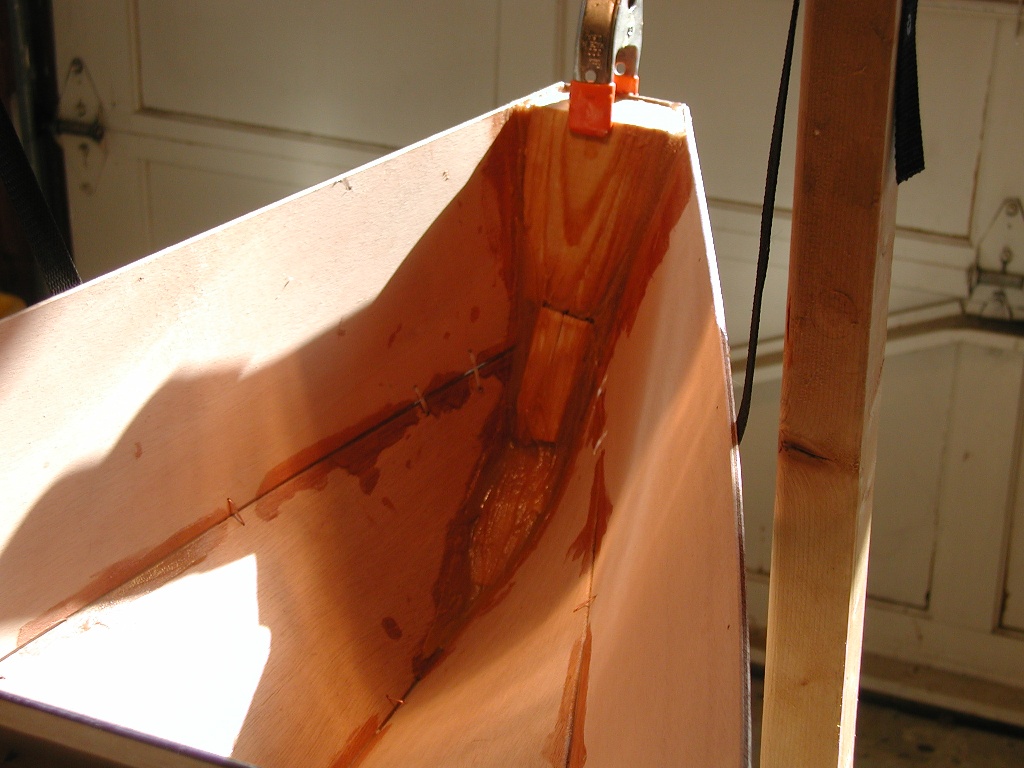
For the rudder attachment, I wouldn’t bother with the 3rd eyebolt. For one thing, it adds difficulty to the build. 2 points define a line, 3 define a plane. If you use 2 attachment points you are guaranteed to have a hinge line, albeit potentially slightly off vertical. With 3, you have to line up the eyebolts exactly to avoid binding (which could cause wear and the very failure you’re trying to avoid). For another, the weak point in the rudder attachment is not the eyebolts. It’s the attachment points in the hull. Instead of adding another eyebolt, I’d beef up the stern of the boat so that the bolts stay anchored and the forces are smoothly transferred to the hull. When I was building my WD12, I planned ahead for possibly installing a rudder and used a chunk of 2x4 as a sternpiece instead of the specified end pour. It was lighter, cheaper, used less epoxy and had no chance of voids.

It also provided plenty of bonding area to both the deck and hull. I would recommend something similar in your case, with bedded through-bolted eyebolts.

I think that you’d get a better result on the akas if you left it at 8 strips. There’s no real reason for a 9th strip. Once bonded, the akas are as thick as a baseball bat. Another layer is simply gilding the lily.

Also on the akas, while the 6 oz glass would help with abrasion and provide a true composite construction which would resist flexing, an 8-layer lamination wouldn’t have much flex left in it anyway and you do want a bit since any tri-hull is 3 boats sailing in close formation, each meeting a different wave. You need a little bit of flex to absorb the differential forces. If it was my boat I’d either use 4 oz glass or skip it entirely. If I wasn’t skipping it, I’d glass all the aka surfaces, rather than just the 2.

I don’t see any point to increasing the ama bulkhead thickness or to using 6 oz glass on them. They support the shape of the hull mostly against compression. Any compression that needs such a beefed-up bulkhead would crush the hull where it spans the bulkhead, so reinforcing the bulkheads is a waste of effort and materials. The only reason I can see to glass the bulkheads is in case you’re using the space inside the ama for storage and want to protect the bulkheads from abrasion and 4 oz is good enough for that.

I’d stick with the 3 mm okoume for the amas, but glass it inside with 4 oz glass. That would provide better resistance to punctures than using 6 oz glass over the entire outside. I’d leave the outside 4 oz and add an additional layer of 6 oz on the bottom for abrasion resistance. I’d also coat the outside bottoms of the boat and amas with an epoxy/graphite mix. This would resist, not prevent, scratches and punctures and be easy to touch up and repair.

Nor would I bother with any extra bulkheads for the triple. Besides the arch of the deck making for a pre-stressed monocoque structure, it has what looks like 5 deckbeams supporting that span. If you really want to reinforce the deck, I’d say glass the underside, instead.

I’m 100% with you on skipping the screws for the mast step. To me they are always a weak point in an otherwise bonded wooden structure. They act as stress concentrators, cut through the grain, can spall (depending on the material), have a different thermal coefficient of expansion than wood which can result in them working loose and allow water to get in and, worst of all, require you to punch a hole in that lovely, light watertight hull you spent so much time and effort building.

Good luck,

Laszlo

Awesome! I was hoping you’d chime in. It does seem like most rudder breakages have been with the eyelets ripping out, not the actual rudder snapping, so you’re probably right that 1/2 is adequate. And yea, it seems the internet is split on whether a true foil shape really matters much for a boat like this. That’s a good point re the downsides of three eyebolts. I had read about adding a stern piece and it seems like a good option. Did you just cut it roughly to size, slather a bunch of thickened epoxy, secure the stern piece with a clamp, then add fillets along the edges? I suppose I would just make it large enough to reach the sheer clamps? Then I drill out large holes, fill with thickened epoxy, redrill and use butyl tape on the eyebolt threads?

I can’t find the threads mentioning problems with the ama bulkheads anymore, but I think it was re: where the aka connects to the bulkhead. Any suggested enhancements there?

Thanks!

Yes, I bedded the wood in epoxy/woodflour putty and filleted all the edges to get a smooth force transfer with no force concentrators. And since all the gaps were filled with putty, I didn’t need to be worried about fine joinery.

Rather than butyl tape I’d use something like 3M 5200 to seal it and hold it in place. Just be aware that if you go this route, it’ll be a long cure time and a permanent attachment. If you expect to need to remove the bolts, use silicone sealant, instead.

Regarding the aka/ama attachment and bulkheads, I’m not going to make any guesses without an accurate statement of the problem. I don’t want to give you bad advice based on a guess.