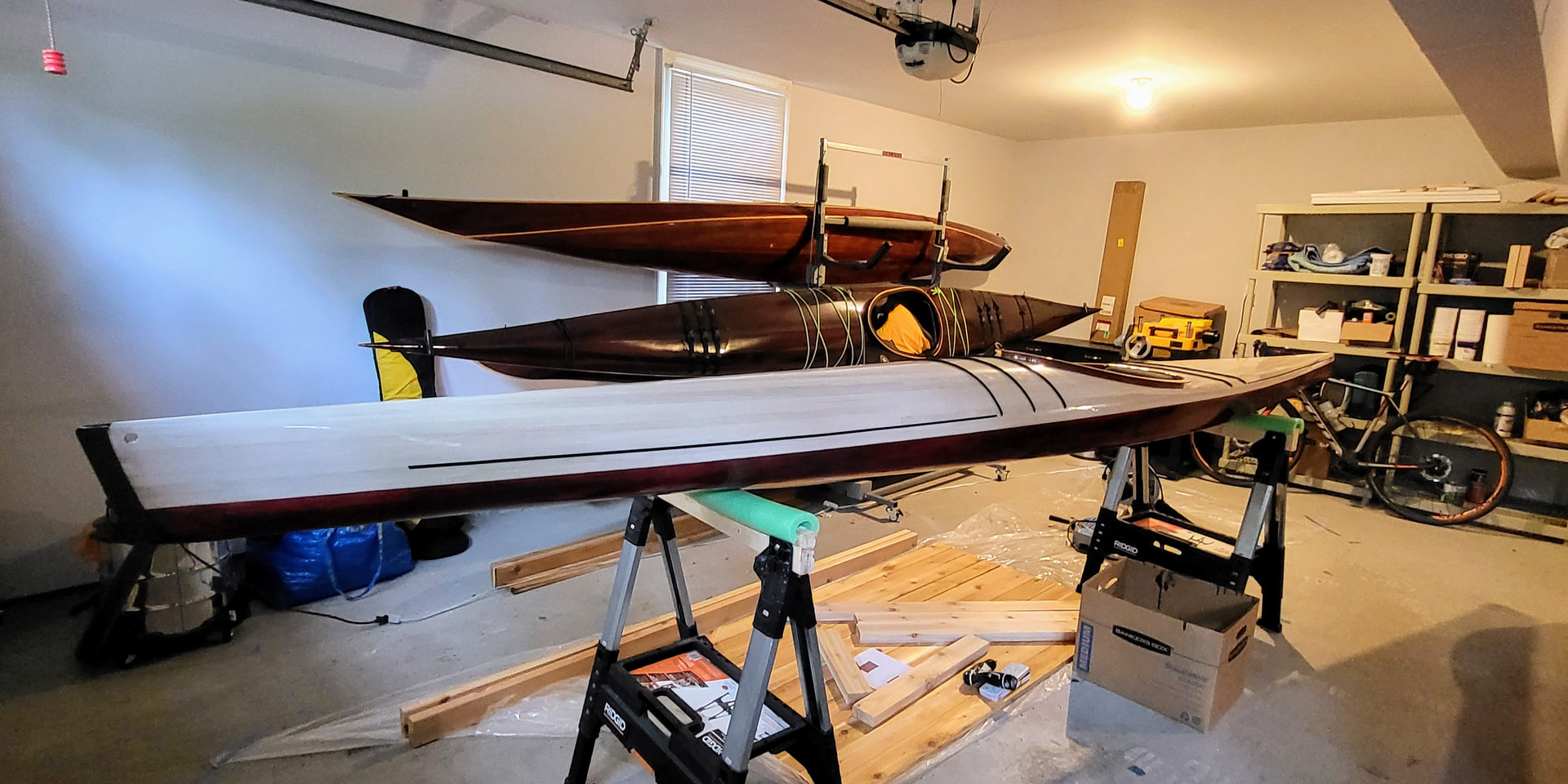
I have cut the bead and scarfed my shear strips and am looking to install them. The bend is fairly severe the last two feet of the bow and stern. In Nick’s Petral Play video he showed how he made the ends of the shear strip more pliable by cutting wood on one side using a hand plane. Nick did not use bead and cove strips, I will be. The only flat side I have to work with is the bottom of the strip where I had removed the bead. If I plane it from that side as Nick does in his video, I am worried that I will be crushing the shoulders of the cove strip. Do I:
Just go ahead, taking wood off the bottom of the shear strip and maybe set the two shear strips on it’s side to prevent hurting the cove?
Take wood off the top of the shear strip, taking away the cove. This will require me to take the bead off of the cheater strip that will come in contact with the top of the shear strip when I install that cheater strip.
Another option I just thought of, I have some old bead and cove strips from a previous canoe project. I could take off the cove from a couple of 3 foot strips and use them as a support for the shear strip as I plane it I could flip the shear strip putting the cove onto the sacrificial piece bead. This way I could plane it the same way Nick shows without damaging the shear strip cove.
Dave, thanks for the suggestion. I agree that would solve my conundrum. Only issue is aesthetically I am looking to have my outer stem and shear line be made of the same white cedar and where they meet, I would like to have them as close to the same height as possible. Taking both the bead and the cove off and then planing the shear strip to bend down up to the tip of the bow and stern would minimize that effect.
i think i understand the problem you are describing. i have built a number of strip builts with a lot of spring in the shear including the petrel play, petrel, and night heron.
the approach i use for the shear strip is, to not only take the bead off, but basically rip that strip so that it is no more that 1/2” wide. then it typically makes the bend easily. it’s very difficult to make the upsweep on the shear line happen with a 3/4 inch wide strip…and you will find that if you watch his videos and actual builds, he is using a narrower strip as his shear line….and then he is even taking a bit more off of it.
here are some pictures of my builds that show a 1/2 wide shear strip:
anyway, in sum, based on my experience, you want your sheer strip to be no more that 1/2 inch wide in order to handle this upswoop. and with that narrower strip, you may not need any additional thinness in the strip to get it to make the bend.
let me know if i understood the essence of your question and if the proposal makes sense.
Once again you are a font of knowledge and I appreciate the effort in helping me. I understand what you are saying. So where I am is as follows. I have a scarfed full length shear strip (about 19 feet) with flat on the bottom and a cove at the top. On the stern side I already planed it down to about 1/2” at the tip. The stern bend is not too bad and the shear strip as is should make it. My options appear to be:
Be out 6 strips (the number of strips used to make the two shear strips) and start over as you suggest with a 1/2” strip flat on both sides
Cut of the cove from my existing strips and cut it down to a 3/8” strip, flat on both sides
Try to plane the bow side as I did the stern side, maybe having to go a bit thinner at the tip, maybe looking at soaking it with water then hitting it with an iron to improve the bend.
I differ to your greater experience. Which direction would you go?
To further complicate this, even if I went with the third option, I was thinking of removing the cove on the shear strip. Since my next strip would be a straight strip, I would need cheater strips to fill in and it looks like it would be a real pain to put in cheater strips with a bead and cove arrangement.
Well Nick said installing the shear strip would be a tough experience!
After a run with no other distractions, I think I know what I will do. I am going to take the cove off the shear strip (suggested by Dave earlier) and plane the bow side as I did the stern side earlier. With no cove, the strip will be more more pliable. I did a test piece, and it will easily make the bend at the bow. I will take the bead off the next strip that will go on top of the shear strip, giving me an easier time in putting in the cheater strips since I will not have to deal with recreating the bead each time I modify a cheater strip as I try to fit them. Again, thanks for your help!
at the end of the day there are a lot tricks to approach all kinds of minor ‘problems’ that arise in building a kayak - especially a strip built. having built a lot of these and being sort of a ‘launch and learn’ guy - i have explored a lot of these ‘probems’. (Note, i am good at what i do but not a guy who you would want doing surgury on you).
a couple other things did come to mind that i wanted to share that seemed relevent to the situation that you can keep in your pocket should you experience them…that are particularly relevent to strip builds which are, in a lot of ways very tolerant to production ‘oops’:
save every scrap of strip until the project is done. in strip building, you have all kinds of sizes of that strip wood you may need. so until the project is done i just keep all the bits (i usually keep better/larger bits forever)….never know when it will come in handy….perhaps you are looking for a color or grain match and having saved that piece is a lifesaver. i once miscutt a piece and found in my box a little tail from the exact same strip….my repair ‘disappeared’. even save pieces of strips that were purposely cut and glued to adjacent strip or glassed - like cutting out the cockpit hole for hull…
if you muck up a piece, you can often repurpose it. scarfs can be undone (unglued) or just cut out and redone. (you may lose an inch) or a knot in the center of a strip can be cut out and you have two half strips that will come in handy later. any piece you muck up is subject to 1 above.
for my strip builds, and this depends on what you are trying to accomplish aesthetically….i am trying to ensure a random floor like effect so i am typically scarfing shorts and longs and different lengths….which allows me to build with, typically, very little waste (this is related to above) so in my parsimonious approach i am getting a fourth boat worth of strips for every boat i build becuase a typical margin is you buy 20 to 25% more of what you need. i realize this does not work for every aesthetic - book matched full length strips….but for most of us that does not come into play.
strips are sandable without having to worry about exposing underlying material like plywood. This is a fantastic property to take advantage of in a repair or redo situation.
the strength of the structure is the sandwich of glass, woodcore and glass. the strips can be cut into all kinds of little pieces and glued together and then glassed without having a substantial impact on the boats strength. there are some boats i have seen that look like works of stained glass. with relevence to this thread, i once mismeasured and cut out the cockpit incorrectly. i didn’t realize my mistake until about a week later when i went to fit the the cockpit sill. becuase i had saved what i cut off (again, see point 1), i simply reattached it, and recut it, and the repair disappeared.
Not to hijack this thread, but an observation and a question-
Cove and bead is faster than planeing the edges, but there’s no shame in a hybrid approach - plane the challenging parts and C&B for speed-running the simpler areas.
Question - I like the idea of using the shear as an accent line. If I’m going to make a special shear strip, any suggestions for a wood other than cedar that would work, and still be amenable to the tight up curve in a Petrel Play?
Here in the UK we don’t have a great deal of choice, so I used tulip wood, also known as poplar as the sheer strip and other accents on my petrel play. It’s quite a bit harder than WRC and as this was the first strip took a lot of work to bevel, taper and bend, but in the end I think it was worth it.
on your observation, yes, you can mix both cove and bead as well as handplaned edges. i do it all the time. that said, once you develop your skills with a block plane, it really does not take that much more time. not a lot of people have the tooling to reliably make their own cove and bead…..anyway, that’s where i got my start when i inherited a pile of hand ripped strips from an abandoned project.
interestingly, i find the cove and bead works best in conditions that are relatively easy to handle with a block plane. you can only twist wood so much to get the cove and bead to mate without a big gap on a section with a lot of twist, so in those times you need to resort to planed edge anyways.
on accent strip material, agree with what everybody said above. as mentioned in my post earlier in this thread, a narrower accent strip is often easier to bend to the shear then the standard 3/4 wide strip. the positioning of a shear strip typically, involves little twist but it does often have ‘spring’ … so if you go with a standard strip you are trying to bend the wood along the 3/4 inch face…which is tough. 1/2 inch wide strips often gets you the aesthetic you are lookng for with the bendiness that you need.
another idea for accents i wanted to throw out there and just started to experiment with is automotive pinstriping. i tried it for the first time and made it through my first season without anything coming off. unlike a built in strip, you can change colors and move them around as it suits you. in this boat, i was looking for black - not an easy color to find in wood. here is my first boat with that technique.
classic wooden boats often had gold leaf or white as an accent strip….so it is not inauthentic. but you don’t find a lot of pinstripe painters these days…the tape does a great job with a lot less skill required