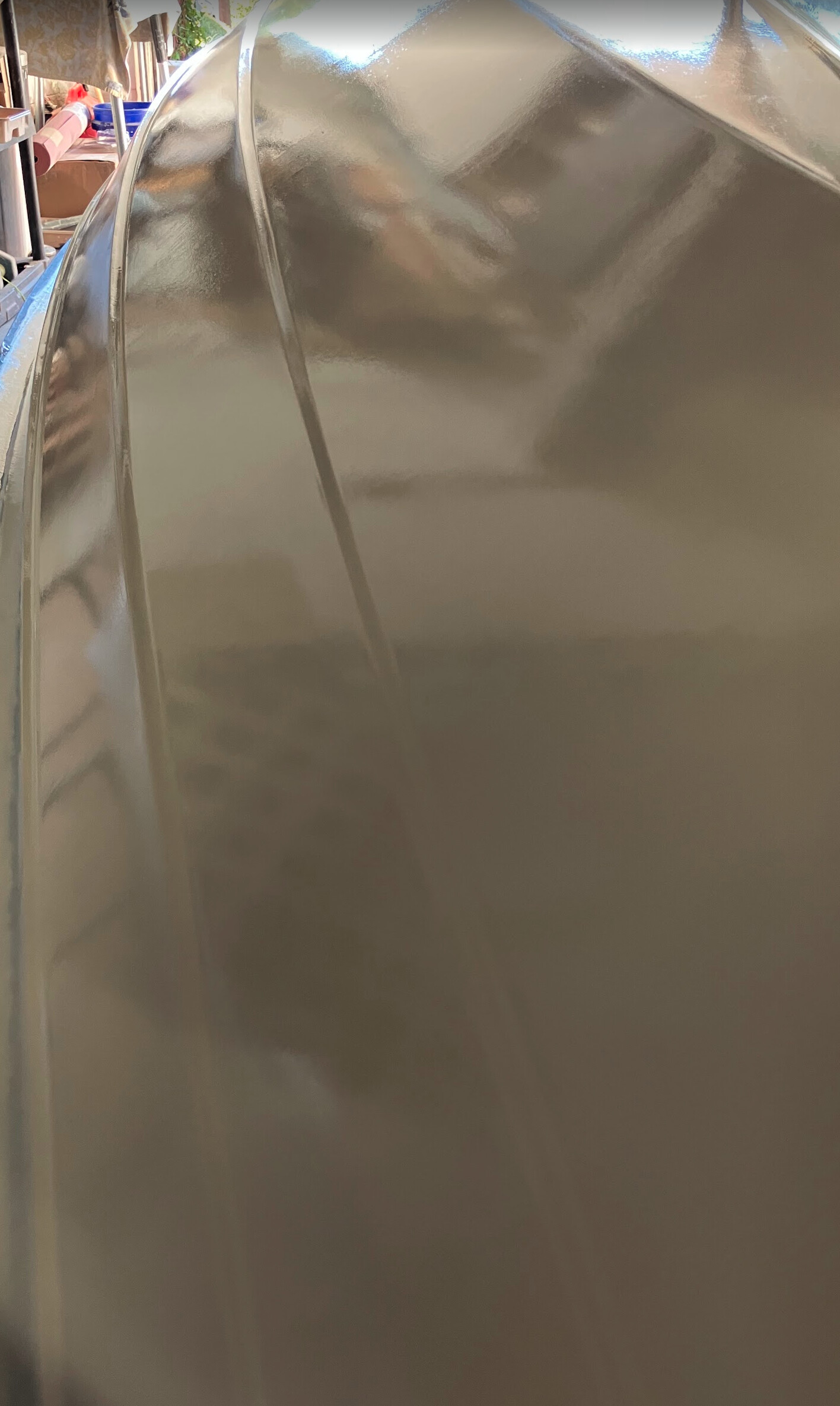
So the TL;DR is that the second coat of Toplac Plus has resulted in rampant orange peel and roller tracks and I don’t know exactly why.
This is my first time using any sort of marine paint. I applied 2 coats of Prekote, sanding after each with 220. I was impressed with that product and how level and smooth I was able to get things. The first coat of Toplac Plus when on nicely as well. I was perhaps slightly reckless as I knew I would be appplying a second, and likey a third coat. The paint leveled nicely and I was surprised at how good a single coat looked. I did have a few runs, and some tracks and orange peel where my application was less than perfect, but nothing major. I wet sanded those out prior to the second coat. Rinsed with water, wiped dry, and hit the whole boat with a tack cloth prior to the starting the second coat about 20hrs after the first.
Right away the second coat did not seem to go on as well. The roller was pulling up a lot of orange peel, and leaving more tracks than the first time. I’d hoped they would level, but several hours later all of the orange peel and tracks are still there. It practically looks like anti-skid in some areas. There are some areas that don’t look terrible, but even the best parts of the second coat are not as smooth as the first. It really feels like it just completely failed to level out at all.
I have a few ideas of how to improve. One is to trash the rollers I have been using. They leave heavy tracks no matter the technique or amount of paint. To some degree I think I can blame the orange peel on all of the back rolling I did to try to chase way the roller tracks, which didn’t end up working anyway. I think the rollers are too soft. They load up with paint but won’t let it go without enough pressure to leave tracks. I can’t figure out why the first coat would be so much better than the second though. I have a bag of rollers from the CLC finishing kit that I should have used, and will on the next coat.
The temp and humidity were squarely inside the range for Toplac Plus, so there shouldn’t have been a problem there. I am wondering if the partial quart I started the second coat with lost some of its solvent while still in the can. To my knowledge I sealed it up tightly, but I guess it is possible. If there was a loss due to evaporation, it would have needed thinner which I do not have anyway.
I think to be safe I will tip out the third coat even though it shouldn’t be strictly necessary according to Interlux and the internet.
That is about all I can think of as to why the second coat is such a disaster. I’m listening to all suggestions and criticism.
What type of rollers are you using? I have used the 4” white foam rollers from Home Depot very successfully with Toplac. I typically apply with one roller and very, very lightly tip with a second dry roller to break the bubbles. Use very thin coats
I am using a 4” white mini roller with the rounded ends from some online retailer. After looking more closely now that the second coat has dried to the touch it does seem like excessive rolling may be the culprit. Hopefully the switch to clc rollers helps after I sand back the orange peel and roller tracks.
The worst of it is on the bottom.
The sides didn’t turn out too bad, although there are a few spots here and there that are unacceptable.
The good news is I am really happy with the color, Ivory. I also have some Sapphire Blue, and Sundown Buff. I plan to use.
It appears to me that you are putting it on far too thick. The CLC rollers will make the problem worse IMHO. When I paint Toplac I put it on in very, very thin coats. Essentially as thin as possible
Thanks, I will try to apply the third coat much lighter. I knew that when the roller was full the paint was going on too heavy, so I tried to stretch it as much as possible. The rollers I was using got very soft and floppy after only a few minutes of use. They seemed to hold a lot of paint and became very pressures sensitive. To much pressure left tracks, any less than that and basically zero paint dispensed. I’ll carefully try the CLC rollers since I have a dozen or so of them and go as light as possible. I shouldn’t need much coverage anymore with two apparently heavy coats applied.
I typically just barely dip the roller into the paint - I never submerge the full roller. Then I roll it around on the tray before applying to the hull. After applying to a section I “tip” with a second dry roller with the lightest possible pressure - just enough to break the bubbles.
You probably should sand the present layers with 180 or 220 grit paper until the hull is smooth before doing the next coat I always do at least 4-5 coats
I wet sanded the whole hull with 320 after the disastrous 2nd coat. Whats another 3 hours of sanding in the grand scheme, right? For the most part that smoothed things over with a few ares to touch up. The next coat will be the 3rd and thin as I can reasonably make it. I will definitely need a 4th and I’m guessing a 5th. I thought I was going to get away with 3 coats, but so be it. I’ll be much more careful on the interior where I surely do not want any extra-curricular sanding.
the 3rd coat went better than the 2nd by implementing the suggestions (thanks @David_Dewitt1 ) but still has some flaws. I will lightly wet-sand the worst areas and continue with the 4th and probably 5th coat. I think I have a fairly decent procedure now, and have adjusted my expectations to match my circumstances.
The more I learn about this product, the more I realize what a terrible choice it was for me in my situation. I know it is capable of achieving a stunningly beautiful finish even for a DIYer, but it is not a good fit for me. Next boat will be professionally painted, painted in a rented space, or full-on workboat finished. For now, no choice but to forge ahead!
I’ll bet you a nickel that once you have it out on the water you won’t notice.
I’ll bet you $5 that once it’s on the trailer at the ramp, none of the spectators will notice; they’ll be too busy admiring the boat and congratulating you on building it yourself.
Laszlo
1 Like
@Laszlo_Morocz I am sure you are right. I’m not going to lose sleep over it now or ever. When I am not actively being frustrated I still really enjoy the project and I always like looking at the boat.
+1. I would also recommend carefully Watching Nick varnish a kayak. I know you are painting but I learned a ton about painting (and varnishing) from watching Nick’s video.
I’ll check it out for sure. Hopefully this weekend I can get the last two coats on the outside of the hull. I was going to do a boot stripe and maybe some other work, but I think for now I’ll just get the whole thing painted. I still have some pre-finish work to do on the interior so the sooner I can turn over again the better.
One other thing that really helps is getting light at the right angle. I put three coats of Toplac on mine and I thought it looked pretty good, until I turned the yak on its side to get a better look. It looked horrible had to wet sand and put two more coats on. Using a light stand with the boat on it’s side made a huge difference
Yes, I have struggled to get the good angles to see what is happening with the paint. I wonder if the Ivory color makes it particularly challenging. In the right light, the 3rd coat looked fairly successful, or at least what I was willing to accept; no tracks, and only a few textured spots to deal with. On closer inspection it was as disastrous as the first and second coats.
I spent 5 hours wet sanding yesterday, and a couple more hours this morning after walking away exhausted last night, cursing the fact that I chose a 19’ lapstrake boat. That’s all the time I have, and not a drop of paint this weekend. It’s time to admit that I will surely run out of warm enough weather to paint with the garage door open and the central furnace off. I’ll have to start painting again in spring of 2026 which is a real drag considering how close I came. I should probably stop anyway and continue to do research/watch videos, as I seem to be applying paint only to sand it off again. I am closer to a repetitive stress injury than I am to a painted boat.
Tried the roller application with Toplac Plus because I heard it was faster. I’ll go back to what I know with Interlux over the decades, which is brush application. I can brush out overload; I can add in skips - all as it occurs. Mind, there’s no going back except the lightest of tips. But at least I know what is going on.
Your mileage may vary …